Marina Cooley is an educator, hobby researcher, and emerging voice on work-life balance.
As an Assistant Professor in the Practice of Marketing at Emory University’s Goizueta Business School, she is known for her innovative teaching and standout course development. Determined to help the next generation of leaders rethink how they live and work, Marina created a first-of-its-kind MBA course, Happiness Blueprint, in which she takes student groups to Denmark to study one of the world’s happiest countries and its cultural approach to work-life balance. In 2026, Marina was a visiting scholar with Copenhagen Business School.
Marina shares her research and ideas on her Substack, Prof Off Duty, and with a community of hobby enthusiasts on Instagram. Her hobbies include tennis, home DIY, and all things Denmark.
1) You’ve spent a lot of time studying the research on hobbies and the benefits of having them. What findings have surprised you most and/or changed your own thinking about why hobbies matter? And, what have you found are the levers that make hobbies so rewarding (e.g., enjoyment, mastery, autonomy, social connection, having an identity outside of work, a mix of these or something else)?
Let’s start with the problem: the US ranks 24th on the World Happiness Report, way down from a past high of 11. Americans feel burnt out, lonely, anxious, and stuck in what I call the Black Hole of Modern Life.
In contrast, Denmark ranks at the top of the World Happiness Report. Inspired by this statistic, I designed an MBA class called Happiness Blueprint and traveled to Denmark with 25 of my students to find out what the Danes get right about happiness. I found a surprising answer hiding in plain sight; everywhere I turned, I saw hobbies. Corporate execs, working parents, students—96% of Danes have at least one.
When I returned, I dove into hobby research. One study that measured cortisol levels in healthy adults before and after 45 minutes of art-making found that making art lowers cortisol at a statistically significant level. Only 45 minutes!
Another looked at 79,000 adults over 50 across 19 different countries and linked hobby engagement to a 29% lower risk of all-cause mortality. That’s after accounting for a wide range of confounding variables. If there were a supplement on the market that could lower mortality risk by a third, we would not be able to keep up with demand.
Hobbies keep us learning new things, connect us with others, and often get us moving. But most importantly, having a hobby gives us a Third Identity, separate from who we are at work and who we are to our families.
Psychologists have found that holding multiple identities acts as a buffer to distress. When one domain falters, like when we have a bad day at work or feel like we’ve messed up as a parent, our other identities stabilize us.
Every time that we step onto the pickleball court or sit down at the pottery wheel, we’re reinforcing that our worth doesn’t hinge on a single aspect of our identity.
2) What common misconceptions are there about hobbies, and is there anything you see folks claiming more confidently about hobbies than the science currently allows?
I often hear: “once I find balance at work/get my life under control/get through this busy season, then I’ll get a hobby.” We have this idea that perfect conditions for hobbying will arrive someday. But balance isn’t a shiny pebble we can find on our way to work, so that’s the wrong order of operations. Perfect conditions may never arrive. Instead, if you want balance, get a hobby. Having a hobby forces you to define your boundaries as a worker, as a parent, and as an individual.
The second misconception is that hobbies are frivolous or reserved for a certain type of person–like the retired, the wealthy, or the eccentric. Once you see the research linking hobbies and well-being, you realize that, really, they’re an insurance policy against burnout. That’s foundational, not frivolous.
And hobbies are available to all of us; they can be affordable, and they can be accessible. Yes, sailing is a hobby, but so is taking a 15-minute puzzle break.
3) In my research for The Fun Habit, I was a bit taken aback (but maybe not surprised) that so many framed hobbies as frivolous yet never looked critically at the hours they spent scrolling or watching television. Why do you think an activity we actively choose can somehow feel more indulgent than passive leisure?
We live in a world that profits from our attention, and every day we navigate platforms designed to keep us scrolling. When we’re tired, it feels like the easiest option is to do less, scroll passively, or bedrot. Our instinct tells us we want rest, platforms encourage the scroll, and passive rest becomes the default. It doesn’t feel indulgent because it doesn’t even feel like a choice that we’ve made.
But we have agency. People report the highest happiness levels when engaged in challenging activities that require concentration (like sports, music, and creative activities) compared to passive leisure. Engaging in a hobby might require overcoming a little friction (putting on your tennis gear, setting up your paint supplies, signing up for a class), but the reward is far greater.
It’s similar to your PLAY Model; many hobbies belong in the Living quadrant. There’s higher challenge, but also higher reward.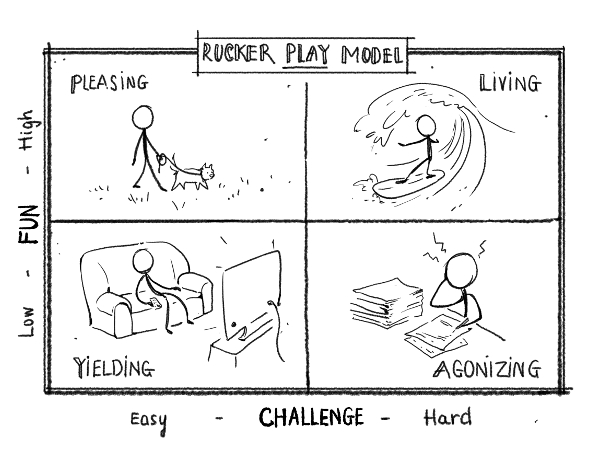
4) How much should we trust our initial (or renewed) reaction to a hobby? One of the problems with being a beginner is that the first few attempts can feel awkward or frustrating. Alternatively, sometimes you see someone return to what once brought them joy only to abandon it quickly because it feels awkward to begin again. How do you distinguish “this isn’t for me” from “I haven’t stayed with this long enough to discover what might become rewarding about it”?
Recently, I spoke at a consulting firm about hobbies, and a very energetic, clever young woman came up to me after my talk. She told me that she went to one tennis lesson but didn’t go back because she “sucked,” so it wasn’t for her.
Work and school have rewarded us for mastery. We think we should either be good at something immediately, or that we need an eternity to master it. Many of us are familiar with Malcolm Gladwell’s 10,000-hour rule, which he popularized from psychologist K. Anders Ericsson’s research on deliberate practice. But being a world-class anything is a pretty ridiculous standard for something that’s meant to keep us out of the Black Hole.
Less known is Josh Kaufman’s theory that we can learn the basics of almost anything with about twenty hours of focused practice. The steepest part of the learning curve happens early, so if we can get past the initial frustration, we become competent quite quickly. You don’t have to hit exactly 20 hours to decide whether something is right for you (know thyself), but keep Kaufman’s theory in mind as you push through the initial learning curve.
5) You’ve developed a framework around choosing a hobby that counterbalances the stress of your daily life. Can you walk through your methodology, as well as explain why a hobby might sound appealing on paper but not actually be the hobby that will light us up?
If hobbies function as a kind of medicine, then the question becomes how do you prescribe them for yourself?
When I returned from my first Denmark trip, I decided to try 17 hobbies in one year, which gave me hands-on experience in a wide array of hobbies and the opportunity to interview experienced hobbyists.
What I’ve learned from that experiment and four years of research is this: the best hobby for you is one that offsets your unique daily pressures.
I have two different kinds of days. During the first, I sit alone in an office, reading and writing. By 5 pm, I miss human interaction and being outside. These are my tennis days; I need to run around the court and whack a ball with no room for deep thought.
On the second kind of day, I’m in a college classroom interacting with 180 humans in eight hours. By the end of those days, I need to be alone. My perfect hobby is hanging some strips of wallpaper in my house in total silence.
Everyone’s daily pressures are different! To find your hobby, try this framework:
- If your day revolves around metrics (revenue, grades, productivity, follower counts), choose a hobby without rankings.
Try: playing an instrument, sketching, journaling, photography, book club, gardening. - If your work is digital, choose a hobby where you make something tangible.
Try: knitting, woodworking, pottery, baking bread, puzzles, Lego sets, home DIY. - If your work demands precision, choose a hobby where you’re forced to be imperfect.
Try: beginner dance classes, learning a new language, improv, choir, watercolor. - If your work is high-stakes, choose a hobby with low consequence.
Try: mahjong, video games, adult coloring books, trivia nights, crochet.