Why do we keep coming back to some things and quietly walk away from others?
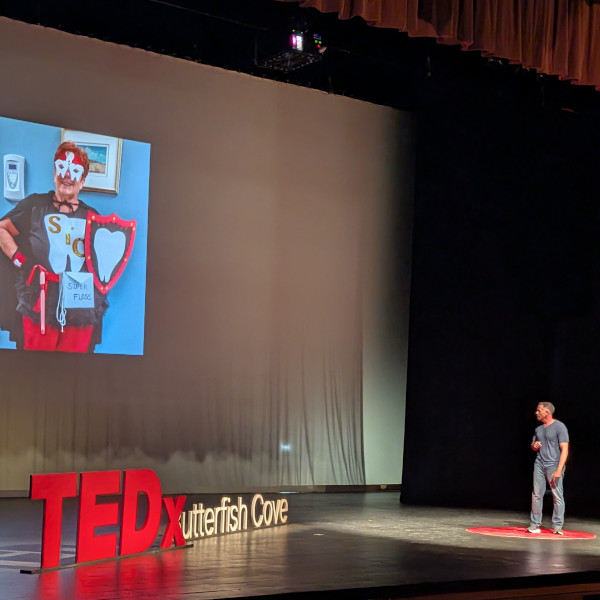
It’s a question I’ve been circling since The Fun Habit, and a couple of weeks ago I got to answer it on the TEDx stage: We don’t return to things just because they’re important. We return to things that give us a reason to come back.
It turns out I’m not the only one circling this question. One of this quarter’s interviewees, Dr. Marina Cooley, who studies hobbies (how fun is that?!), found that the hobbies we tend to stick with aren’t the impressive ones; they’re the ones that offset the pressures of our day. And many of my fellow TEDxButterfish Cove speakers also had their reasons for returning to what mattered. For Eric Rittmeyer, a former Marine, it’s the clarity of pausing to ask whether discomfort is challenging him or damaging him before deciding whether to push on. For Scott Rosenfeld, who lights the art at the Smithsonian, it’s the simple act of noticing how well he’s seeing something before trying to see it better. For Kim Kelley, it’s a set of six questions she asks before calling anything a solution.
The common thread that emerges is that most of us benefit from having a compelling reason to come back to what matters to us. I call that returnability.
And my take on returnability is this: Enjoying life isn’t just waiting for us on the other side of getting through the hard parts. On the contrary, designing for enjoyment now, as a mechanism for getting through the hard parts, is one of the most successful ways to live a fulfilling life, especially for those who want to play the long game. And, it also tends to make life a lot more fun. 🙌
Leading thought: Marina’s research makes a compelling case that hobbies aren’t just a reward we earn once life finally calms down. They’re one of the ways we create that calm in the first place. Rather than waiting for balance before picking up a hobby, she argues the order of operations should run the other way. When you find a hobby you enjoy enough to sit with, it forces you to draw the boundaries that make balance possible. Just as important, a hobby gives us a “Third Identity,” separate from who we are at work and who we are to our families, so that when one part of life falters, our sense of worth has somewhere else to stand. Seen this way, hobbies are less an indulgence and more an insurance policy against burnout.
Action to take: Use Marina’s framework and choose a hobby that counterbalances your day. If your day runs on metrics, pick something without rankings. If your work is digital, make something tangible. If it demands precision, try something that forces you to be imperfect. If it’s high-stakes, choose something low-consequence. Then give it a fair shot. The steepest part of the learning curve comes early, so don’t let one awkward first attempt convince you it isn’t for you.
Want more? Click here to read my discussion with Marina Cooley.
Leading thought: Five TEDx speakers (Heather Chirtea, Kim Kelley, Eric Rittmeyer, John Huffington, and Scott Rosenfeld), five very different lives (an aviator, a survivor turned systems thinker, a Marine, an exoneree, and a lighting designer), yet each arrived at the same insight: we rarely control our circumstances, but we have a real say in how we see them, and that shapes how fully we live. For Heather, losing her sister turned small, passing joys into “LIFE!” For John, decades of wrongful imprisonment taught him that his thoughts were the one piece of real estate no one could take. Kim reminds us that problems look different from inside a system; Eric that discomfort can either challenge us or damage us; and Scott, quite literally, that changing the light changes what we see.
Action to take: Pick one situation that’s weighing on you right now and look at it again in a new light. Start with Kim’s first question: What am I actually looking at? Separate what you know from what you’re assuming. Then borrow Eric’s test: Is this discomfort challenging me or damaging me? Finally, take John’s lesson to heart and decide which story about it you’ll let take up space in your head. The circumstance may not change, but how you live with it can.
Want more? Click here to learn from five of my fellow TEDxButterfish Cove speakers.
This quarter’s life experience is an easy pick. On September 17, I gave my first TEDx talk at TEDxButterfish Cove in Ocean City, Maryland.
I’ve given a lot of talks and keynotes over the years, but I’ve never prepared for one like this. Eleven months from first draft to stage. Ten versions of the script. There were even a few costumes involved, which is all I’ll say about that for now. I’m excited to share more with you about it next quarter when TED posts the video.

I continue to support various causes through quarterly contribution, which is now being tracked on this scorecard.
I went back and forth about whether to share this bit of the story, because I still don’t really know what to make of it, but it seemed a shame to keep it to myself, so here it goes…
I don’t consume a lot of short-form content nowadays, but when I do, about half of what’s served up to me is comedians. In that regard, the algorithms have me pegged.
Over the years, I’ve watched thousands of comedy clips, especially while researching the epigraphs for The Fun Habit. In all that time, I can’t recall being served up a Mitch Hedberg clip, and I feel like I would remember that because Mitch is one of my and my brother’s favorite comedians (my brother and I got to see him live, and Mitch tragically passed away only months after that show).
The night before my talk, alone in my hotel room, I was predictably ruminating on the day ahead. So, I decided to open YouTube to distract myself from the anxiety. After a couple of scrolls, my feed was suddenly nothing but Mitch Hedberg shorts. Clip after clip, I’d scroll past one, and the next would be another.
If you’ve read The Fun Habit, you may remember how it opens:
In memory of Brian Rucker. When we meet again, I hope I find you with Bourdain and Cornell, drinking scotch and eating well, accompanied by Farley and Hedberg, who have us all in stitches. Your memory serves as a reminder to make the most of every day, which includes seeing this book through to the end. As a result, there is going to be a lot more fun in the world, and I know that would make you happy. I love you, bud.
I’m pretty much a secular person. I don’t have a mental model for explaining how a recommendation engine turned into a message from my brother (and, maybe, Mitch as well), and I’m not going to pretend I do. But I also wrote an entire chapter of that book called “The Mystery,” and the point of that chapter was never that moments like this prove anything. The point was that experiences of wonder don’t require belief. They only require that we notice them and resist the urge to explain them away immediately.
So I noticed, and I let myself feel like Brian was there, in exactly the company I’d hoped for him, the night before what felt like the biggest talk of my life. I don’t know what else to tell you. It made me laugh, and then it made me cry (a lot), and then it made me laugh again. I imagine Mitch would have appreciated the timing.
As always, if you made it this far, thanks so much for reading. I’m truly grateful you’re here. 🙌
Warmly,
Mike Rucker, Ph.D.