In September 2026, TEDx came to Ocean City, Maryland, for the first time, and I was fortunate to share the TEDxButterfish Cove stage with an extraordinary group of speakers. This interview is a compilation of conversations with five of them: an aviator, a survivor turned systems thinker, a Marine, an exoneree, and a lighting designer. In no particular order, they are Heather Chirtea, Kim Kelley, Eric Rittmeyer, John Huffington, and Scott Rosenfeld. Rather than asking one person five questions, I asked each speaker one question that built on their talk. Each answered from very different life experiences, yet a common thread emerged: how we see our circumstances shapes how fully we live them.
Heather Chirtea | Entrepreneur + Aviator
Heather Chirtea is an entrepreneur, aviator, and the first woman in the United States to own and pilot a flying car. Founder of So Fly and multiple successful technology ventures, she has built companies, led national experiential tours, and delivered millions of dollars in educational technology to schools. Now leading America’s flying car revolution, Heather combines firsthand innovation with high-energy storytelling to inspire audiences to embrace bold ideas, outpace fear, and become the architects of tomorrow’s future.
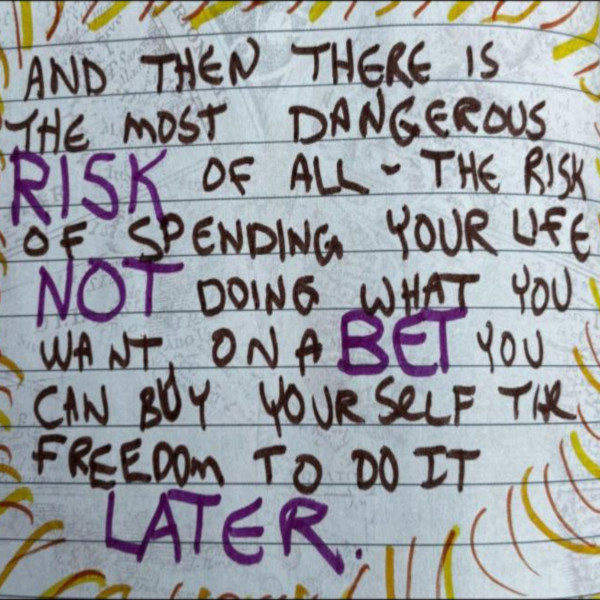
Q) In your TEDx talk, you shared a line from your journal about the risk of spending your life not doing what you want while assuming you’ll have the freedom to do it later. After the untimely loss of your sister, how did your understanding of passion and freedom evolve, particularly around the idea many of us share that there will always be time to pursue what matters to us?
A) I think evolution is the correct term. When I was younger, I thought I was invincible, perhaps nearly immortal. There was always a baseline assumption that there would be time in the future to do whatever I desired. The loss of my sister was so abrupt that my whole psyche shifted. When you use death to inform life, suddenly every life choice matters. And not just a little. I almost had a sense of near-urgency around everything I pursued. Good wasn’t good enough. I wanted “extraordinary”! It applied to my career, my personal relationships, my business dealings. I cut all toxic people out of my life. Those are the big sweeping changes.
But something more subtle shifted… the moment-to-moment joys… the little things that we pass by on a daily basis. A swarm of butterflies that was unexpectedly on the shoreline when I was 4-wheeling. The smell of soft rose lotion that always reminds me of that winery in France. The sheer thrill of the momentary free-fall when I throw myself off the 40-foot rock climbing wall. Those things used to be small pleasures in passing. But now they are LIFE! …in such a big demonstrative way! …and my appreciation for those joys is so important that I strive to string them together from moment to moment, and not just in a passive way. Those thrills are everywhere when we seek them out, and assembling them into a day becomes an almost near-exhaustive pursuit. Some days I literally run from place to place, packing it all in.
When I die, I want to skid into the grave at 90 miles an hour, screaming the whole way there. I want to know that I saw ALL the colors, felt ALL the pain (yes, pain), and soaked up every drop of dew in the field of life. It’s hard to live like this, almost eternally dissatisfied with “Good enough” and at the same time eternally fascinated and happy with every moment that proves itself to be more important than I originally thought. I laugh a lot, more than most. And I tell you, it’s hard work, this happiness business.
Maybe next I will learn to cry. In the same way I didn’t fully pursue happiness, I also avoided pain and packed it away. A huge part of the evolution was also learning to allow pain to hurt, in the same way I allowed myself to live uplifting experiences more fully. But that’s for another TED talk!

Kim Kelley | Training Executive
Kim Kelley was born and raised in one of the world’s most infamous international cults. After surviving 20 years of systemic abuse, including child trafficking, Kim escaped and transformed her lived experience into a mission of prevention, education, and systemic change. Today, she is an executive at a Tier-1 training facility where she collaborates with law enforcement, survivors, technology companies, and community leaders to develop survivor-informed solutions that bridge the gap between awareness and action — proving our greatest challenges can become catalysts for meaningful impact.
Q) You offered six considerations for evaluating a system. Can you walk through those six and explain why we often miss systemic problems when we look at systems too narrowly?
A) When I evaluate a system, I ask six questions, and the order matters:
First, what am I actually looking at? Before we explain a problem, we need to separate what we know from what we believe, assume, or still need to verify. Observation and interpretation are not the same thing.
Second, what system is producing this outcome? Repeated outcomes rarely exist in isolation. We need to look at incentives, relationships, power, money, information, formal and informal rules, dependencies, and who benefits or absorbs the costs.
Third, what does the problem look like from inside the system? This is the question we skip most often. From the outside, a decision may appear irrational. From inside, given the information, risks, incentives, and perceived alternatives available to that person, it may make perfect sense.
Fourth, what would this solution actually change? Instead of simply asking whether an intervention sounds good, we need to play the movie all the way through. What changes tomorrow? Six months from now? Which incentives changed, and which stayed the same? We have to be careful not to mistake activity for outcome.
Fifth, how will the system respond? Systems adapt. People, organizations, markets, offenders, and institutions change their behavior in response to intervention. A solution that works on Day One may create a very different environment by Day 100.
Finally, what aren’t we seeing yet? This is the humility question. Whose perspective is missing? What evidence would change our minds? Are we even measuring the right outcome?
We miss systemic problems when we narrow our attention to the most visible person, behavior, or failure. The goal isn’t to make every problem look complicated. It’s to discover where the complexity actually lives. Good systems thinking should not paralyze us. It should help us take better-informed action, measure what happens, and remain willing to adjust when the system teaches us something new.
Eric Rittmeyer | Wellness Director + Author
Eric Rittmeyer is a former U.S. Marine who is nationally recognized for his expertise in mental toughness, emotional intelligence, and women’s health. Eric is the author of two books, The Menopausal Marine and The Emotional Marine. A frequent guest on major television networks, he educates audiences on hormone health, genetics, and strategies to optimize both mental and physical well-being.
Q) What do you see as the distinction between discomfort that is telling us something needs to change and discomfort that is necessary for growth? In other words, how do you discern when discomfort is a signal to step back and/or change course versus something you need to lean into because it is a necessary part of becoming stronger and/or a required gate to pass on the path toward mastery?
A) I think the distinction comes down to whether the discomfort is challenging you or damaging you. Growth is supposed to be uncomfortable. If you’re pushing yourself outside your comfort zone, facing fear, rejection, failure, or uncertainty, that discomfort is often the price of becoming stronger.
Mental toughness isn’t about ignoring what you feel or blindly pushing through everything. It’s about having the self-awareness to understand why you’re uncomfortable, regulating your emotions, and then intentionally choosing your response.
I always say, mental toughness isn’t controlling what happens to you, it’s controlling how you respond to what happens to you. Sometimes the mentally tough response is to keep pushing. Other times, it’s recognizing that something isn’t working, adjusting, and changing course.
The key is making that decision from clarity, not emotion. Don’t quit simply because it’s hard. But don’t keep going simply because quitting feels like weakness. Mental toughness is knowing the difference.
John Huffington | Author + Trainer
John Huffington spent 32 years in the Maryland prison system, including 10 years on Death Row. Maintaining his innocence, he ultimately secured his release in 2013 through a Writ of Actual Innocence and eventually became the 191st person in the U.S. exonerated from Death Row. Currently, John is an internationally recognized author & motivational speaker. He is a trainer for statewide training programs in the Illinois Police Academies, presenting Wrongful Conviction Awareness and Avoidance classes. This training is the first of its kind for law enforcement in the U.S.
Q) As a person wrongfully convicted of a crime you didn’t commit, you spent decades knowing something about yourself that the system around you refused to accept as true. What does an experience like that teach you about maintaining a sense of identity when virtually every external signal is telling a different story? In your TEDx talk, you spoke about the “dash” between the dates on a tombstone as the place where life actually happens. After spending so many years with your choices constrained by forces outside your control, what have you learned about what it actually means to make that dash your own?
A) I’ve had two death sentences and spent time on Death Row, and part of that experience is the stripping away of your identity. At some point, I realized along the way there were still things that belonged to me that nobody could take unless I gave them away: my thoughts, my brain, my heart, and my knowledge of the truth.
There’s a line from Scarface that’s stayed with me: “All I have in this world is my word and my balls, and I don’t break them for no one.” That’s where I put my ten toes down. I stood my ground. My foundation was the truth, and I fought for it; I refused to relinquish control over my own thoughts.
That became one of the biggest lessons I took from the experience. Our thoughts are our real estate. We have to learn how to control them rather than getting caught in what I call the “hamster wheel” of what somebody else thinks about us.
Also, when I finally got through everything, I realized the lesson from the poem “Dash” [by Linda Ellis] is part of my message. In my role as a speaker, I try to remind people that all we have is the space between when we’re born and when we die; the dash that separates those two dates. Sometimes it takes a tragedy, an accident, or an extreme circumstance to realize it’s all we’ve got. So, part of my message is that we need to spend more time looking inward, discovering it, and learning how to make the best use of this gift we’ve been given.
So, for me, making that dash your own means understanding the value of our own thoughts and refusing to let somebody else’s view of us overwhelm or wrongly persuade us about who we really are.
Scott Rosenfeld | Exhibit Lighting Designer
Scott Rosenfeld FIES is Exhibit Lighting Designer at the Smithsonian American Art Museum and Renwick Gallery. His research brings together scientists, engineers, and museum conservators to improve visual experience, protect collections, and evaluate emerging technologies. Scott is a Fellow of the Illuminating Engineering Society (IES), where he leads a community of experts to develop ANSI/IES RP-30 Recommended Practice: Lighting Museums. Scott is a contributor to The Museum Environment Revisited (2025), which introduces new frameworks for preserving cultural heritage.
Q) As a lighting expert, your work is literally about how changing the way something is illuminated can change how we see it. So, playing with the word “light” a little, I’m curious whether you think that idea has a broader application. Specifically, what have you learned about our agency in changing perspective, and are there ways we can deliberately view our own circumstances in a different “light” to change how we experience them (e.g., creating a more useful or constructive perspective)?
A) Light is so weird. On one hand, we don’t think about it. We just open our eyes and go about our day. While my TED talk was ostensibly about lighting great works of art, I wanted to give folks tools to manipulate light so they can see better and create whatever mood and appearance they want. How can that not help us see things in a new light? But I suspect the process is as important as the new light: just taking the time to notice how well we see, and then taking steps to make things better, makes things better.
As you picked up, there is a lot of subtext that goes beyond basic lighting design. I spent a lot of time writing my talk, and I surprised myself by starting with that weird statement:
“All we see is light.”
As a high schooler, that sent me down a Kantian rabbit hole. Yeah, I might only see light, but I also saw the cute girl sitting next to me, and she was real. She existed outside my head with its light-receiving eyeballs hanging out just above my nose. Immanuel Kant unlocked some of this by acknowledging that we only know the world as it appears through our own perception, while insisting that a real world exists and can be studied reliably. Eastern philosophies offer another example, especially Tibetan Buddhist Dzogchen, which focuses on being conscious and simply experiencing the inputs, like the light that hits our eyes.
It’s interesting that both Kant and Buddhism also stress ethics: how we choose to exert our agency, and to what ends.
That takes us to your question about how we choose to exercise our agency in controlling our visual experience, which was the core of my TED talk. I got on that stage to share five controllable properties of light (quantity, distribution, color, movement, and angle), to demonstrate how I use those properties to serve artists, curators, and visitors at the Smithsonian American Art Museum, and to explain how you can use the same heuristic to see things better at home.
So, if all we see is light, then I guess shaping light is one of the most direct ways we have to shape our experience.